Unless you've been living in a very dark cave, you'll have noticed that AI is everywhere. And in 2026, all the talk has been about agents.
The jargon is intimidating. Worse, because the technology is so new, the terms keep shifting and people use them interchangeably.
I know, because I was lost in it myself. Having found my way out, I've been helping clients get to grips with AI, and I want to share the single biggest epiphany I had along the way. Once it clicks, everything gets simpler.
First, though, the jargon.
What "agentic" actually means
Technically, any time an AI does a piece of work for you, it's agentic.
The moment AI connects to your systems, you've crossed the line from a simple chat (you ask a question, it answers) to it actually doing work for you. It can read information from those systems, or write it back.
It does that through connectors. A simple example: you connect Claude (or ChatGPT) to HubSpot and Google Drive, and ask it to build a PDF report on your pipeline and save it to your Drive.
That's agentic work. It's a one-off rather than something repeatable, but it's the first step on the road.
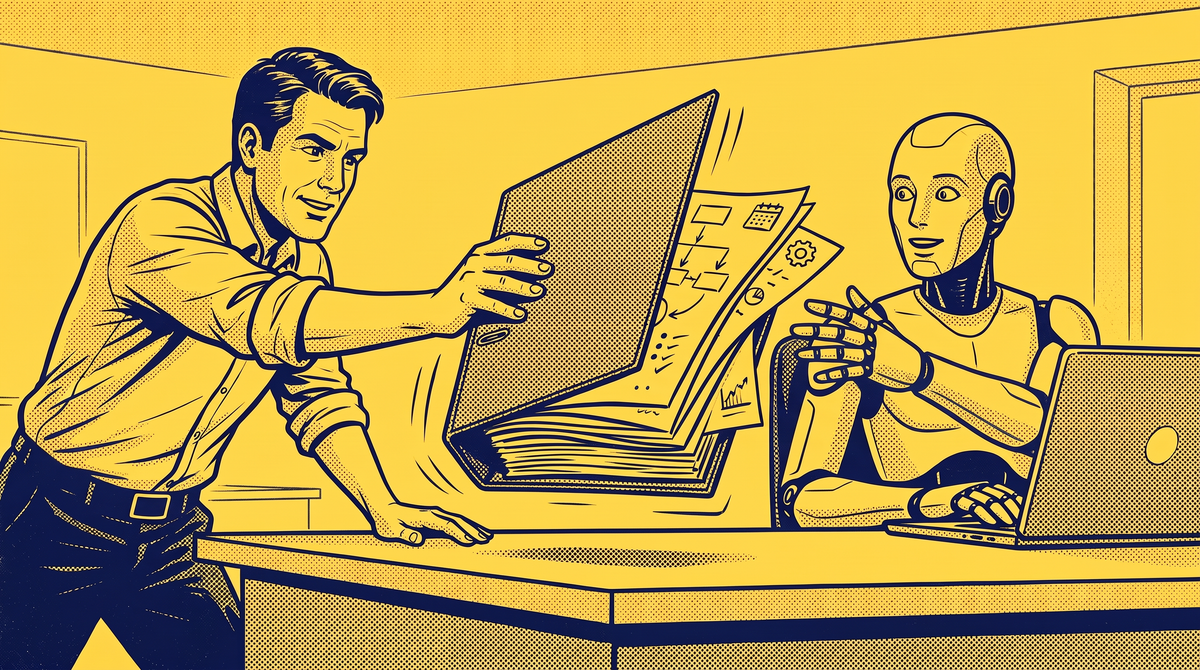
Suddenly AI has gone from sparring partner to colleague.
Agents and agentic workflows are different things
Almost nobody separates the two, and it's the source of SO much confusion. So let's clear it up.
An agent has a goal, an identity and a memory. It's (usually) always on.
An agentic workflow is a fixed series of steps, a task, that you get the AI to complete. You tell it which steps to take, and what good work looks like at each one.
Both use judgement. In a workflow, that judgement is narrow: it works inside the steps you've defined. An agent has far broader autonomy. It decides how to achieve the whole objective, not just how to finish one step.
Trust me here... don't try to build agents to start with. Design agentic workflows. You'll make MUCH faster progress and get much better results.
Documentation is everything
Here's the epiphany.
The biggest barrier to building agentic workflows is documentation.
Look at it like this. Anthropic, OpenAI and the other labs want everyone building agents, so they're working flat out to remove the technical barriers. Every month it gets easier.
What they can't remove is the knowledge in your head: your business processes and your expertise. No lab can write that down for you.
So the first thing every business needs to learn is to write down how its important work gets done. And it's as simple as this:
1. Pick a piece of work you do on the computer every week. Something you'd happily hand to a graduate once you'd explained it. That pipeline report would do nicely.
2. Write down the steps it takes.
3. Write down all the little tips, tricks and bits of knowledge you have about doing it well. The stuff you'd tell the graduate over their shoulder. These are your standards: what good work looks like.
4. Write down every system you use along the way. In AI-speak these are tools: the outside systems the AI can use. Connectors are how it plugs into them.
Steps, standards and tools. That's it.
Write it in an ordinary document, then ask the AI to rewrite it in a format optimised for itself. Think of it as an SOP (standard operating procedure) for your new colleague. In Claude, the result is called a Skill: a file named SKILL.md that it reads before it does the task.
If you've ever onboarded a new rep, you already know how to do this. You've just never had to write it down.
Do it for one task and you've built your first agentic workflow. Do it for a handful and you'll understand agents better than most of the people talking about them.